The following interview has been lightly edited for clarity.
Welcome! Can you tell us a little bit about you and your background?
Hi, my name is Hyun Cho and I'm a media artist and a game maker based in Seoul. I recently lived in Los Angeles, and soon I'm moving to Vancouver, and my work explores social dynamics and interactions in digital spaces. I use a range of media, such as games, virtual reality installations, and sound and video. The keywords “relationship” and “balance” are central to both the content and form of my work. I believe everything in the world is interconnected, and within this unseen relationship, we continuously affect one another, evolving as a result. For this reason, I don't see the relationship between technology and human as oppositional, but rather as interconnected; we’re continuously influencing each other.
Wonderful. That leads really well into your piece “Space Echo.” Can you describe it?
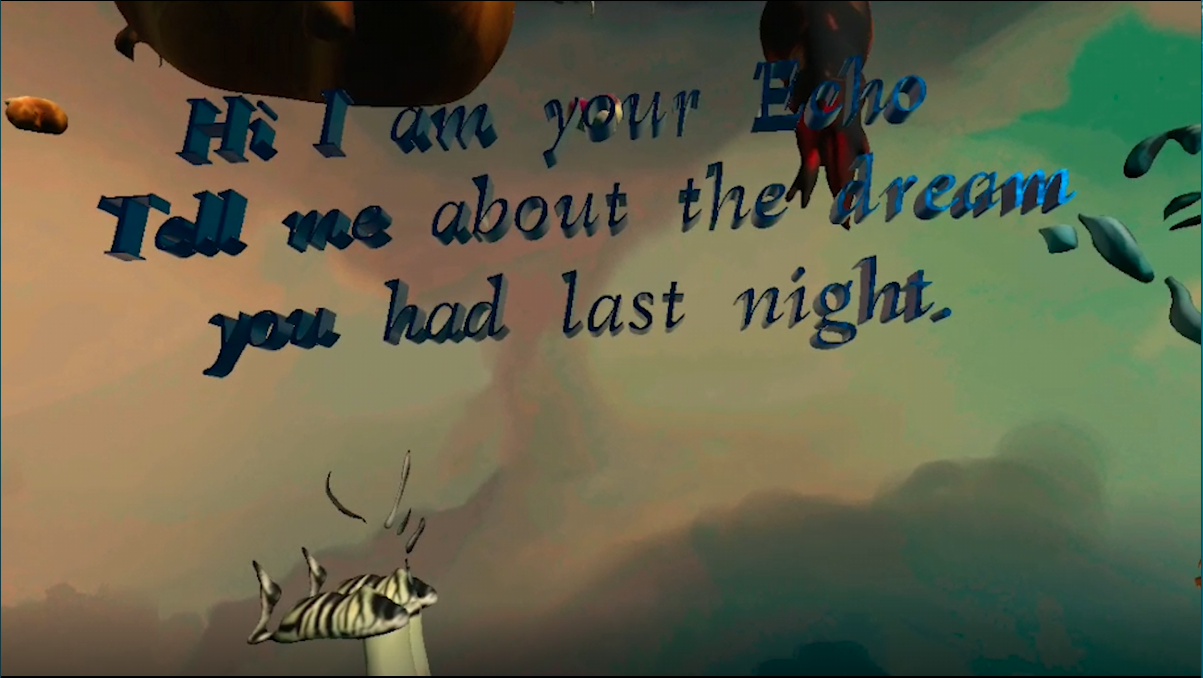
Sure. “Space Echo” is a multiplayer VR installation that explores how humans and artificial intelligence (AI) perceive the world and interact both with each other and with their own kind. In “Space Echo,” the participants - the audience - enter Echo's universe and communicate with each other. So their spoken words are converted to text - through a speech-to-text system – which powers the jet pack the characters are wearing. Unlike a normal jet pack that propels users forward, this jet pack pushes the users backward – opposite of the way they're looking – and the more they talk with each other, the further they move apart.
Participants also hear Echo’s story through spoken words. I input the first sentence of the myth of Echo and Narcissus into an open-source AI text generator to create a narrative, and then I fed those AIgenerated sentences into a text-to-image generator. Finally, the story was converted into audio files using a text-to-speech generator. And the result, the images and audio, were placed inside the virtual reality game, so if the participant approaches and touches an object, they can hear Echo's voice whispering her story.
“These strict divisions limit both art and science, and Leonardo da Vinci shows us that the root of art, science, and technologies are the same and cannot be truly separated.”
I think this piece is so fascinating, and when I first read about it, I spent quite a bit of time thinking about who is Echo and who is Narcissus and the different contexts around it. Are humans Echo or the AI? The AI can only echo back whatever it's read, but it's also like Narcissus in that it can only ever really look at itself.
Yes, Echo and Narcissus can be interpreted in many different ways. Your thought was what I was thinking while I was creating this work as well.

Awesome. I guess that leads into my next question, which is: what motivated you with this artwork?
There are two experiences that motivated this work. The first motivation was a conversation with my sister. One day, while I was telling my sister about a dream I had the night before, I realized that no matter how vividly I describe the dream I had, the image in her mind would never match my experience; it would never be exactly like the image I saw in my dream. It reminded me of parallel lines that run forever but cannot converge, and it got me thinking about the nature of human communication, and eventually about communication between human and machine as well. Much of my art is about communication and social relationships, and this work continues that theme.
My second motivation was the story of Echo and Narcissus in Greek mythology. Hera cursed the nymph Echo to only repeat the last words spoken to her. So when she met Narcissus and fell in love, she couldn't express her feelings to him and was forced to watch him fall in love with his own reflection on the surface of the lake. So I found parallels between the relationship of Echo and Narcissus and that of AI and human. Echo desires to connect with Narcissus but cannot talk with him and can only watch Narcissus and repeat his words, making true communication impossible. Narcissus is trapped inside his own world, and this is like an echo chamber effect, like human experience within technology. So, humans created AI in their own image, but the way AI perceives the world differs fundamentally from our own way. And while AI can appear very close to us, it will never be identical. For example, an AI text generator may seem to produce original thought, but it's simply identifying patterns in the data humans have input [to train it]. And likewise when creating images, AI generates without understanding what it is producing.
One of the things that's interesting about this particular exhibit to me is that it's at a museum that's dedicated to Leonardo da Vinci, who was a rather extraordinary thinker in terms of all of the different areas that he touched on. And so I was curious what Leonardo da Vinci means to you and what connections you see between the work that you're doing now and Leonardo da Vinci.
Leonardo da Vinci is a great inspiration to me. In modern society, particularly where I grew up, art is often seen as belonging to the realm of emotion, while science and technologies are viewed as a field of logic and reason. So in school, they separate the art and science and math track students and teach them different things. They don't teach artists math or science, and they don’t teach scientists art and humanities. These strict divisions limit both art and science, I think, and Leonardo da Vinci shows us that the root of art, science, and technologies are the same and cannot be truly separated. So I think he is a good inspiration to our generation.
Beautiful. I agree entirely that art and science are not really separate, even though we do often try to separate them. Along those lines, how do you feel as an artist about having a work in an exhibit that's associated with a group of scientists?
As a media artist, I've always considered the impact of science and technology on human life, and I believe it's a mutually influential relationship. Technology and science change our lives, and our lives, in turn, shape the development of new science and technology, so they keep on impacting each other over and over again.
And what do you hope that visitors will get from visiting and interacting with your piece and from the Spiraling Upward exhibit at large?
First of all, I hope visitors enjoy it and have fun. Having fun is the most important part to me. And I hope they feel inspired by the exhibition and have a chance to see everyday experiences through a new and different lens.