Notebooks, letters, and artwork left by Leonardo da Vinci (1452-1519) reveal his lifelong fascination with the movements of air and water. He returned to these subjects again and again. As a self-styled “disciple of experience,” Leonardo relied on both observation and experimentation to unravel nature’s secrets. In this, he is much like the scientists who followed, even though most think of him as an artist. Indeed, looking back at Leonardo’s works, we find evidence of many ideas seen in modern fluid dynamics. Here are a few concepts as Leonardo saw them:
As in Water, So in Air
In the Codex Atlanticus, Leonardo wrote, “Write of swimming underwater and you will have the flight of the bird through the air” (qtd in [1]). Here, he intuits one of the fundamental principles of fluid dynamics – that different fluids move in similar ways. Today we’ve formalized this idea mathematically, allowing us to vary the scale and fluid of a problem while maintaining the same physics. This equivalence means that engineers can test small, scaled models of aircraft, wind turbines, and other machines in wind tunnels or water channels (Figure 1). These facilities are often used to visualize how flows move around an object, something that Leonardo thought about in his own work. His notebooks include sketches and descriptions of tanks where he tested flows using dyes, seeds, and other lightweight particles to trace out the water’s movement.
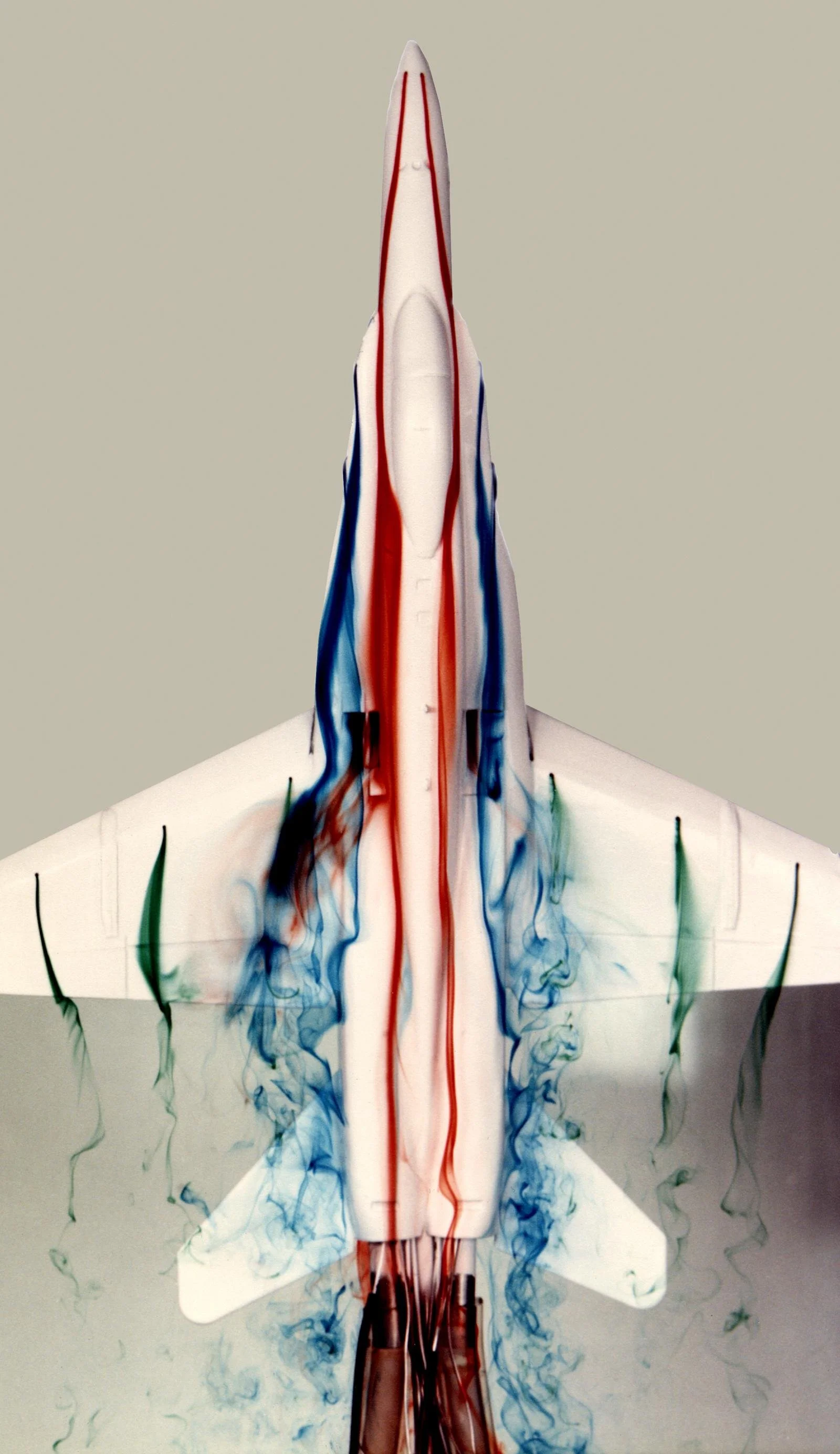
Figure 1: Colorful dyes trace the flow around a 1/48-scale model of an F-18. Photo by NASA.
Leonardo even used these techniques to investigate flows that were not readily observable. In his later years, he combined his knowledge of anatomy, sculpture, and fluid flow to create a cast of a bull’s aorta and visualize the swirling vortices within the heart. From his observations, Leonardo concluded that these vortices helped close the heart valve – something that we couldn’t verify within the body until the advent of magnetic resonance imaging (MRI).
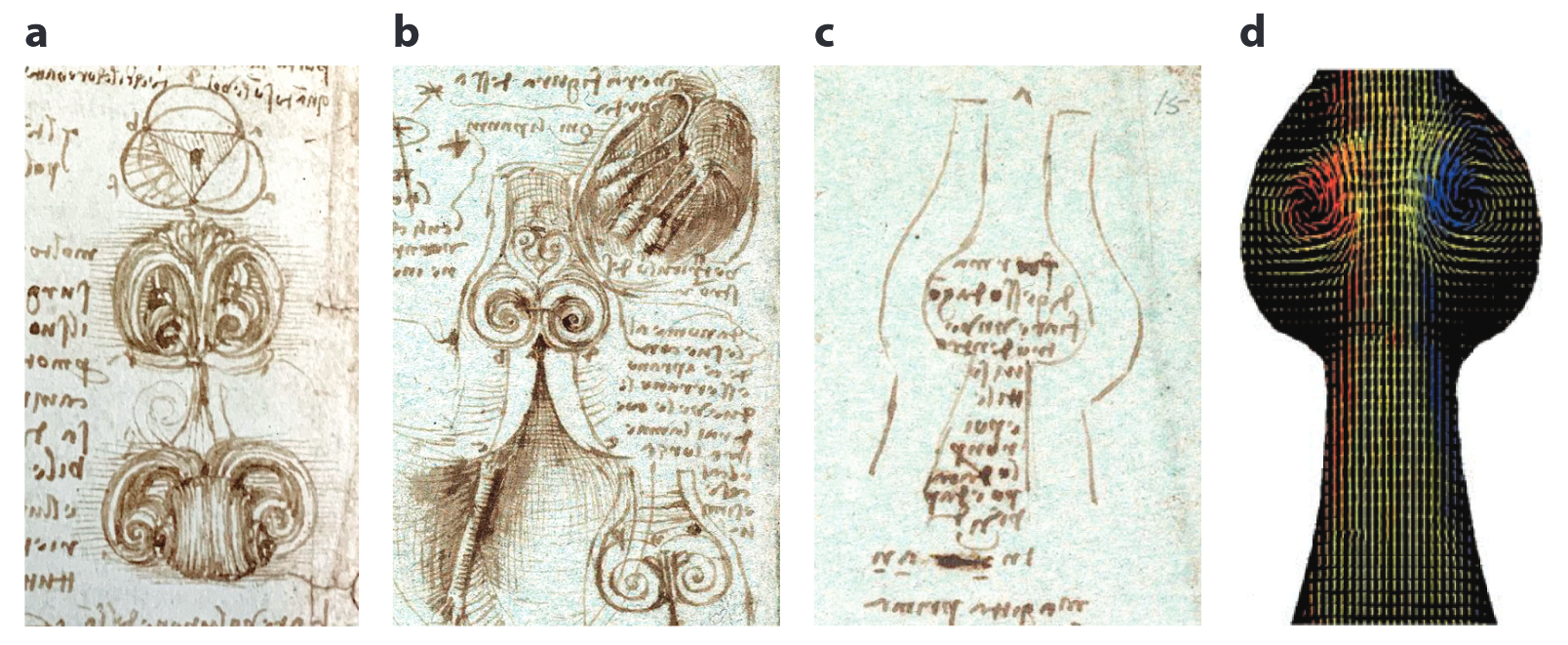
Figure 2: Leonardo’s sketches of (a-b) vortices in the heart alongside (c) his visualization apparatus and (d) the flow in a modern recreation of his apparatus. Adapted from [1].
Friction’s Effects
When a fluid moves near a solid surface, friction slows the flow down. Leonardo references this concept many times, as in the Codex Arundel, when he wrote, “The part of the liquid will be faster in its movement [is] that which is furthest from rubbing with [material] denser than it” (qtd in [1]). He recognized this as particularly important for flow through pipes, where the fastest flow occurs at the center of the pipe, as far from the walls as possible: “The water that rises through a pipe, that which rises highest will be furthest away from the walls of the pipe” (qtd in [1]). Known today as the no-slip condition, this idea was not formalized by scientists until the late nineteenth century. Leonardo’s repeated mentions of the idea remain our earliest known references to it.
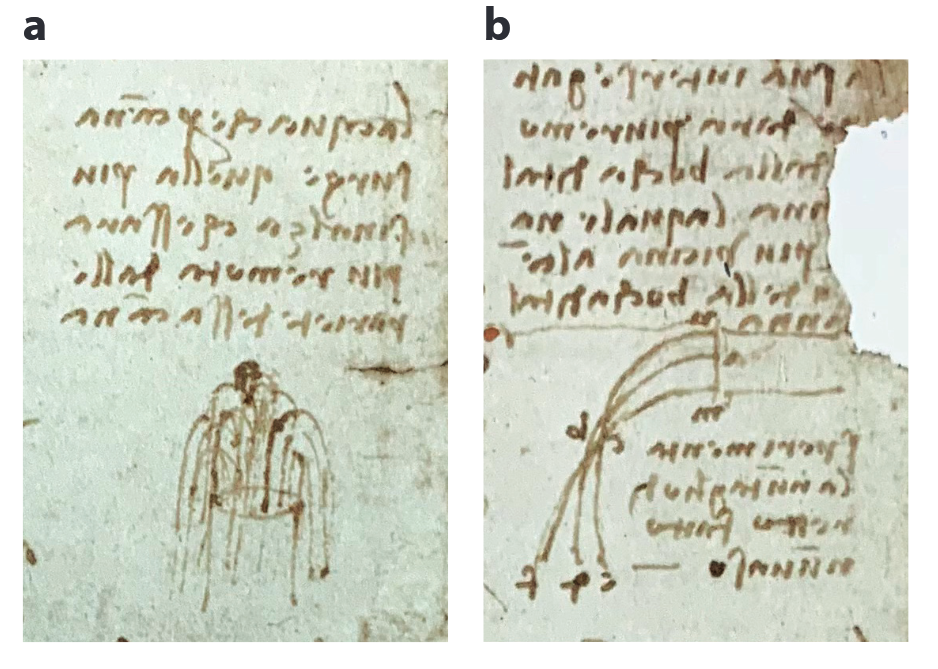
Figure 3: Leonardo illustrates water leaving a pipe. Adapted from [1].
Leonardo even realized that an object’s surface roughness affected how flow moved around it, writing in Paris Ms. L: “the ball being poorly cleaned has a difficult curved rubbing [friction] with the air that surrounds it” (qtd in [1]). Leonardo didn’t know he was touching on a debate that would rage for centuries to come: every baseball used in Major and Minor League games gets treated with special rubbing mud. While, anecdotally, mudded balls seem easier to grip, the effect on a baseball’s aerodynamics seems minimal [2].
Repeating Patterns Across Nature and Scale
Analogies were key to many of Leonardo’s observations of the natural world. Beside sketches of an old bearded man and the wakes of water moving around rectangular posts (Figure 4), Leonardo wrote: “Note the movement of the water level which does as hair, which has two motions, one of which depends on the weight of the fleece, the other on the way of the twists [i.e., curls], so too water has intense turning twists, one part of which depends on the impetus of the main course, the other on incidental and refractory motion” (qtd. In [1]). Here he draws a direct analogy between the movement of the water’s surface and the curls in a person’s hair.
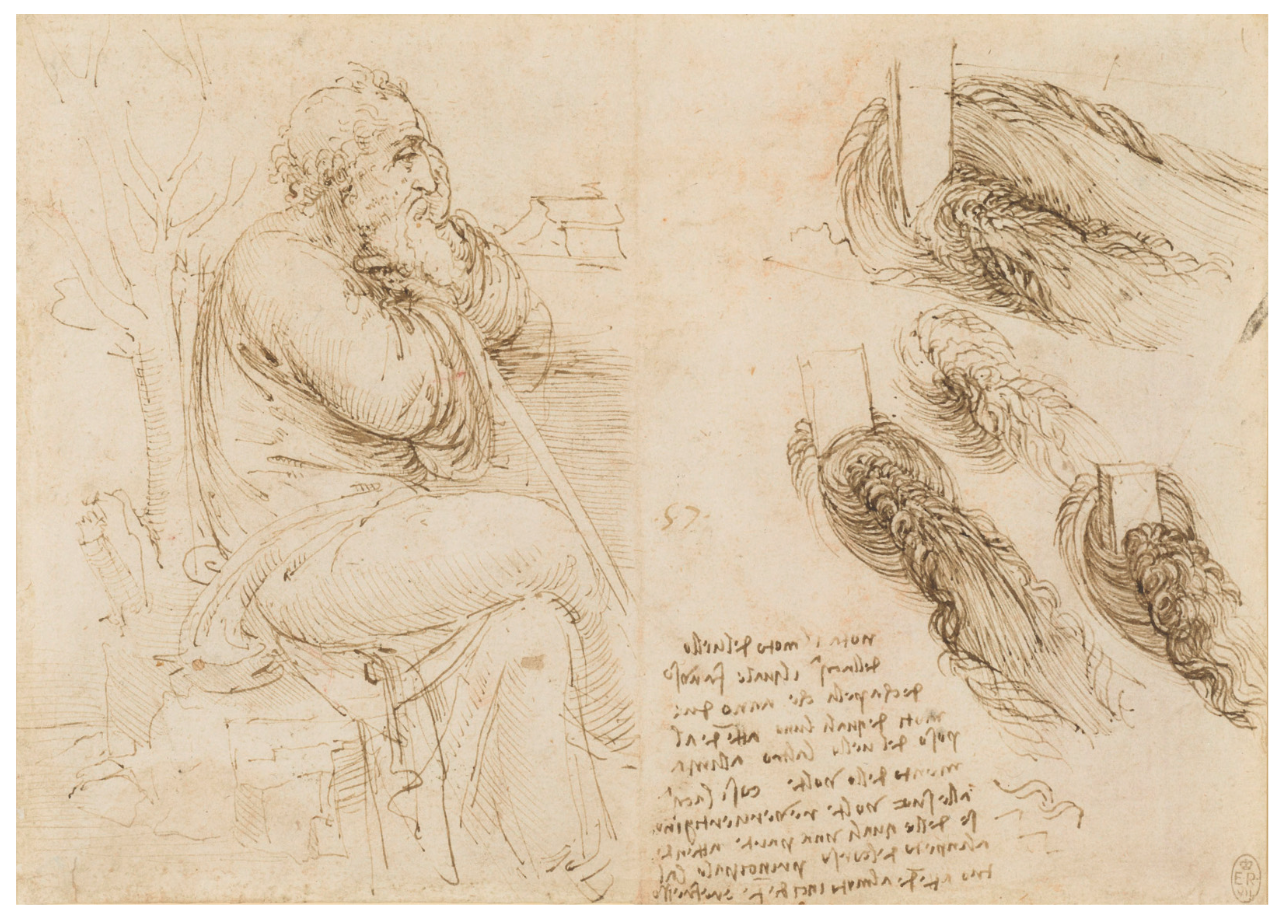
Figure 4: Leonardo’s illustrations of an old, bearded man and water flowing around a post show the same swirling patterns. Adapted from [1].
From his other works, we can see that Leonardo treated this as more than an offhand comment. Zoomedin views of both hair and turbulent water in Leonardo’s works show packed spirals in the same patterns (Figure 5). Whether consciously or not, Leonardo seems to have recognized a universality to the pattern: when looked at up close, water’s swirling eddies are the same as hair’s curls. This is not simply a matter of filling space, either. An analysis of Leonardo’s deluge drawings showed that his repeating spirals were spaced very differently than a random, space-filling packing would [1]. In other words, Leonardo was not merely adding curls and swirls at random; he was trying to reflect underlying patterns he saw in the world.
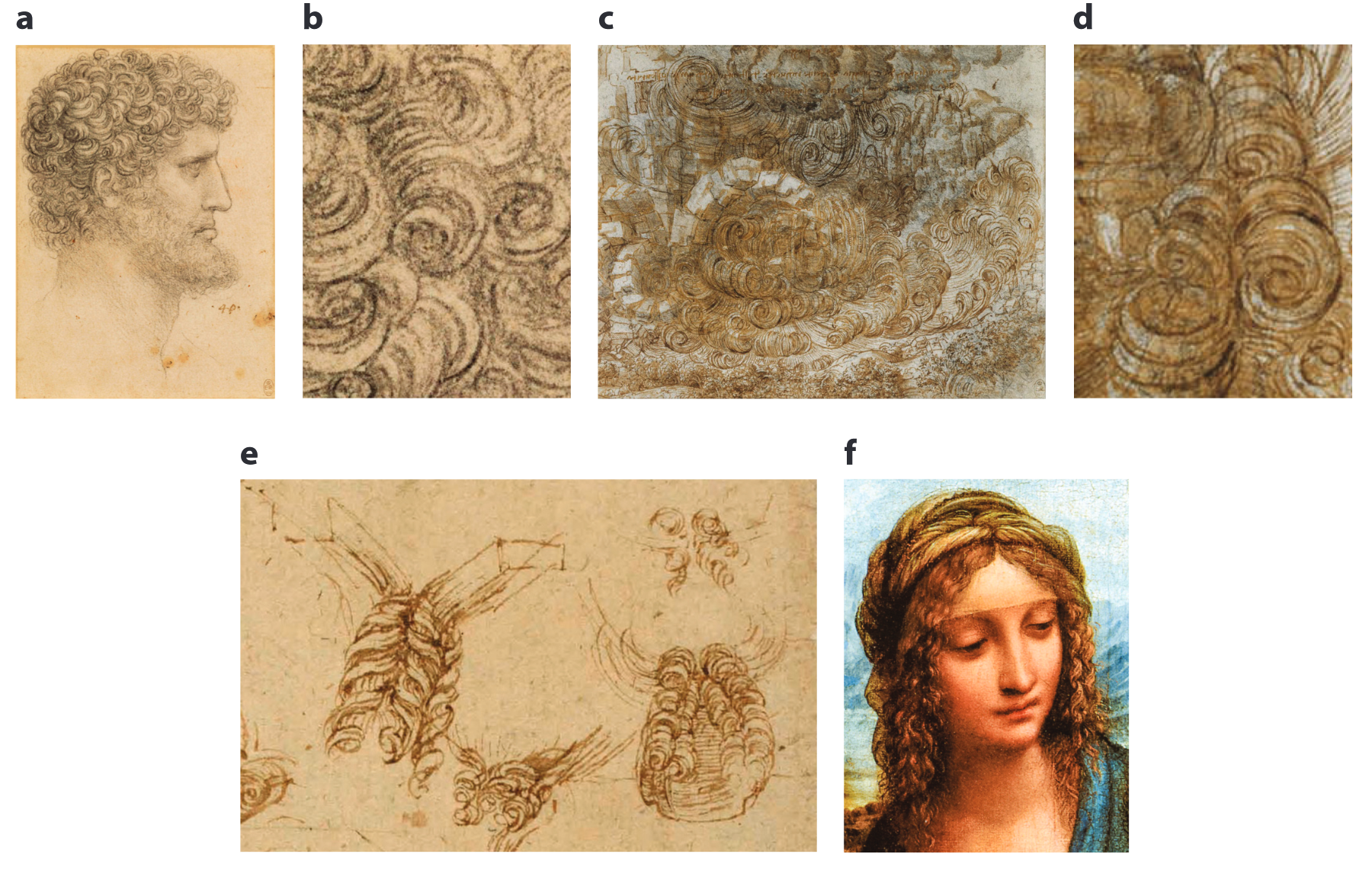
Figure 5: Leonardo’s depictions of hair and turbulent water. (a) Sketch of a bearded man and (b) zoomedin crop of panel a; (c) a deluge drawing and (d) zoomed-in crop of panel c; (e) a wake flow; and (f) zoomed-in view of Madonna of the Yarnwinder. Adapted from [1].
Today we continue to search chaotic flows like those drawn by Leonardo for their underlying patterns. Like him, we have found that the swirling vortices of turbulent flow repeat. Picture a billowing cloud (Figure 6). Some of the vortices will be nearly the size of the cloud – perhaps hundreds of meters across. Those vortices will break down into smaller vortices – tens of meters across – and then ones smaller still. This process of large vortices breaking into smaller ones continues all the way down to the scale of millimeters, where friction in the air is strong enough to damp the vortex out completely. This idea of a turbulent cascade dates to the mid-twentieth century, and, like Leonardo, we still search flows today to find where – and if – this repeating pattern breaks down.
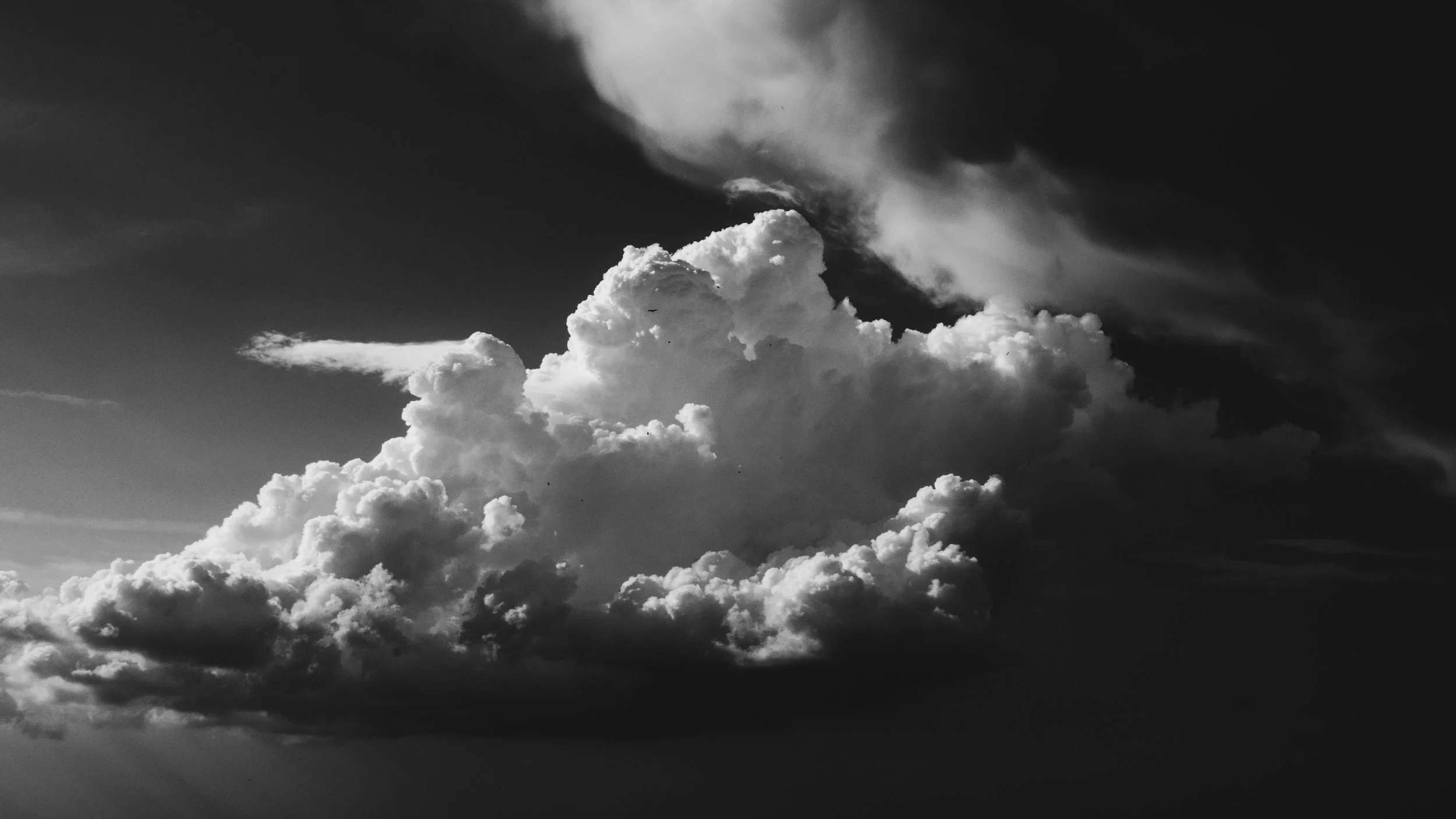
Figure 6: A billowing cloud contains turbulent eddies of many sizes, ranging from hundreds of meters to millimeters in length. Photo by Daniel Páscoa.
Conclusion
Leonardo da Vinci’s notes reveal him as an astute observer of the natural world throughout his life. In many ways, his observational philosophy and willingness to experiment align with our modern view of science, and these traits helped him to recognize concepts that we now consider fundamental to fluid physics. Leonardo saw the same patterns in turbulent water and cascading hair, and he recognized that swimming in water and flying through air were comparable. He used his skills as an artist, inventor, and observer to recreate flows using techniques still recognizable today and, with this, explained blood flow through the heart.
While most of us will never match Leonardo’s artistry, we can cultivate his observational style. Like him, we can record our observations of the world, seek patterns in nature, and return to the topics that fascinate us most. Whether done casually or as part of formal scientific inquiry, we can join Leonardo’s tradition of seeking truth and beauty in the world. Today’s sketches and ideas shape the technologies of tomorrow. Observe the world closely and record your inspirations—they may be the key to breakthroughs waiting to happen.
References
Ivan Marusic and Susan Broomhall, “Leonardo da Vinci and Fluid Mechanics,” Annual Review of Fluid Mechanics, 2021. 53:1–25. https://doi.org/10.1146/annurev-fluid-022620-122816
Andrew Smith et al., “Baseball Rubbing Mud and Its Effect on Roughness: Post #25,” Baseball Aerodynamics, 2019. https://baseballaero.com/2019/07/10/baseball-rubbing-mud-and-its-effecton-roughness-post-25/