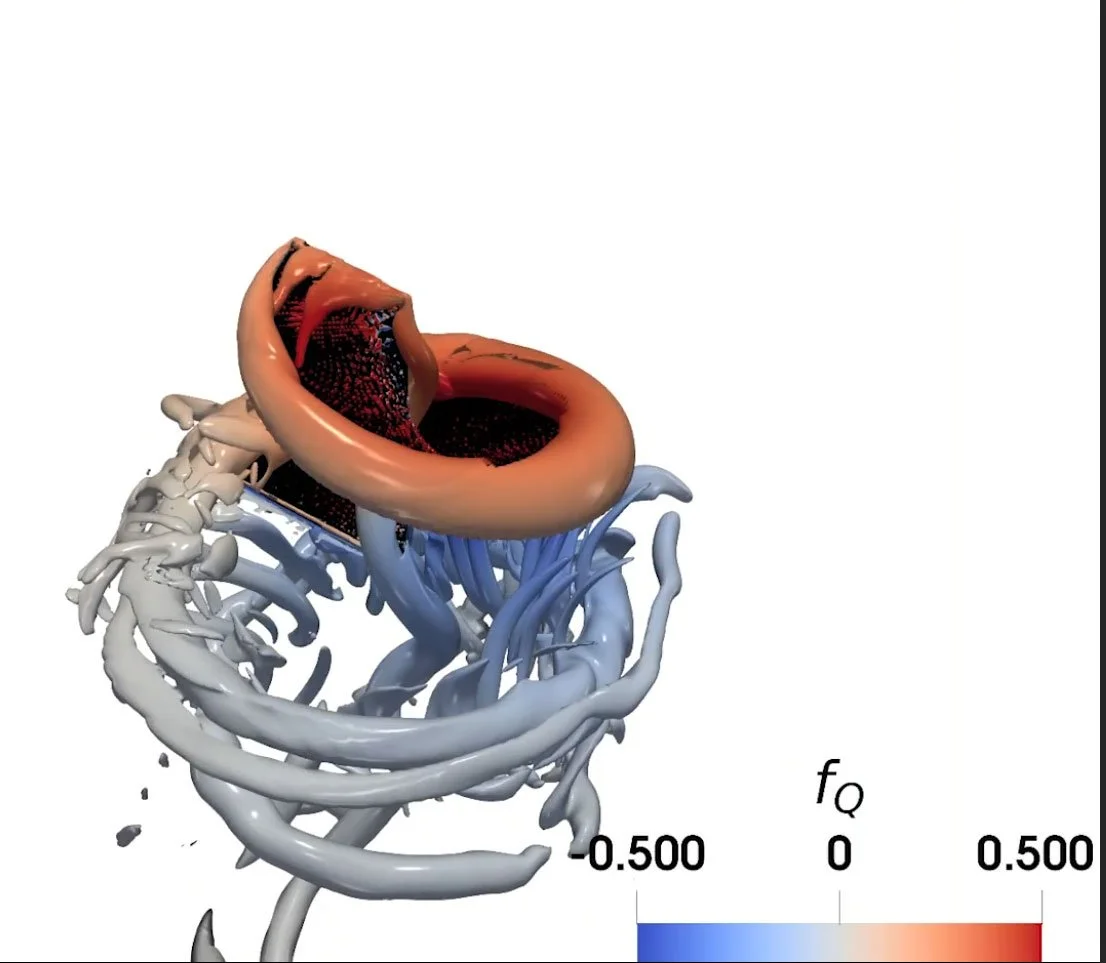
“Aerial Screw (Simulation of da Vinci’s Rotor in Hover)” - Suryansh Prakhar, Jung-Hee Seo, Rajat Mittal
The following interview has been lightly edited for clarity and length.
To start out, can you introduce yourself and tell us a little bit about you?
My name is Suryansh, and I'm from India. I came to the U.S. for my Masters at University of Houston. And after completing my Masters, I shifted to Johns Hopkins, and next year I'll finish my PhD.
What drew you to mechanical engineering?
During my undergrad, fluids was an interesting topic. I like the physics behind it, like equations and everything, and it was interesting at the time, and I thought that I'll probably try to remain in fluids.
So tell us a little bit about your piece in the Traveling Gallery of Fluid Motion.
Drones [are] very popular these days, and they have been used for so many things, like product delivery and for rescue operations, but the noise they produce is generally one of the major hurdles. It's annoying. In the city, we cannot have drones very close to people because there will be sound problems. They could also affect birds and wildlife. So, in general, we have been looking at different rotor shapes that might reduce that drone noise. And da Vinci drew the shape long before we had any rotors. We were actually looking at loop shape propeller. You may have seen the one of them, like the triad propeller was in the news recently. And Professor Mittal's idea was, maybe we should also look at da Vinci's propeller. So we thought that we'll also try to use da Vinci's model to see if we get some acoustic benefit, because that design is also substantially different from the actual drones rotors that we have seen.
So, looking for da Vinci to provide an unconventional answer to drone noise question, despite the fact that clearly he did not have that in mind when he was imagining this originally. And you did simulations of flow around this rotor?
Yes. First, we needed some kind of model to make the geometry model. And searching online, we came across a University of Midland group with several experiments, and they tried to vary different parameters to come up with an optimal design. That saved us a lot of time because then we did not need to run simulations for all the different cases. We had a base case to start with, and [we could] compare it with other propellers, such as loop shape designs or the traditional propeller. Then once we have a geometry, we use our in-house flow solver. Professor Mittal and other PhD students in the past developed it, and we use that to model the flow around the da Vinci aerial screw.
And what did you find?
We see that the noise per unit lift actually decreased. We compared this with the loop shape propeller, and [another loop-based design]. The big picture that we see is that, if we use a large propeller with a larger area, we can reduce the rotation speed, because a larger area generates more lift. Let’s say we have a product delivery, so the weight of the parcel or product is fixed; when we use a larger area with a lower rotation speed, the noise and power both are reduced. Now we use [Direct Numerical Simulation], so our Reynolds number is lower than what you would see in actual flow because of the computational limitations that we have. We haven't checked it experimentally yet, but based on the computational results, it seems that the noise from this larger propeller is considerably lower, for a fixed amount of lift. Also, because we have a smooth spiral shape that distributes the tip vortex throughout the shape of the rotor, that helps it to dissipate faster.
“Drones [are] very popular these days, but the noise they produce is [a] major hurdle. It' s annoying. [...] We have been looking at dif erent rotor shapes that might reduce that drone noise.”
And are you going to try to check it experimentally?
We do not have experimental setup. Our lab mostly works with simulation, [but some collaborators might try it experimentally].
What does Leonardo da Vinci mean for you?
So da Vinci was obviously an extremely talented person. Apart from his paintings, he had so many anatomical drawings of people, of animals, comparing their muscles and bones. And obviously in aerodynamics, he has his aerial screw. And then, for his king or something, he also had a lot of drawings [of inventions] to help in war. And also, I believe, in optics and other fields. So, he was extremely talented and obviously an inspiration. I barely get time to do one area!
It's true. It's true. He made some predictions about flow in the human heart that it took centuries for us to be able to confirm were actually correct.
Yeah. He has some pictures on the turbulence. I think he compared with curly hair and vortices in the heart.
Yeah. He was extremely prolific.
One of the few scientists -- I think maybe Newton comes into my mind -- who has done work in so many fields and excelled at each. That is inspirational. How can someone be so good at so many different fields? Even at that time, it probably would have been very difficult.
It feels hard to imagine living up to that level of breadth and depth. So I'm curious, as a scientist, how do you feel about having your science in an art exhibit?
It feels great. This is the first time I have my art [displayed]. I was little scared, because in science, we have our plots, but it's not exactly eye-catching.
One last question for you: what do you hope that visitors will get out of the Spiraling Upwards exhibit?
This design has already existed for such a long time, but, previously, only a few student projects have looked at it. And I think we can still find that even a design so old -- when da Vinci made it, he had no idea about aeroacoustics, or drone rotors or a helicopter rotor, in general -- and still that design, we feel may still work.
That is a truly incredible idea, that somebody who didn't even see that type of concept fly could have something that would change and improve things for us now. Thank you!