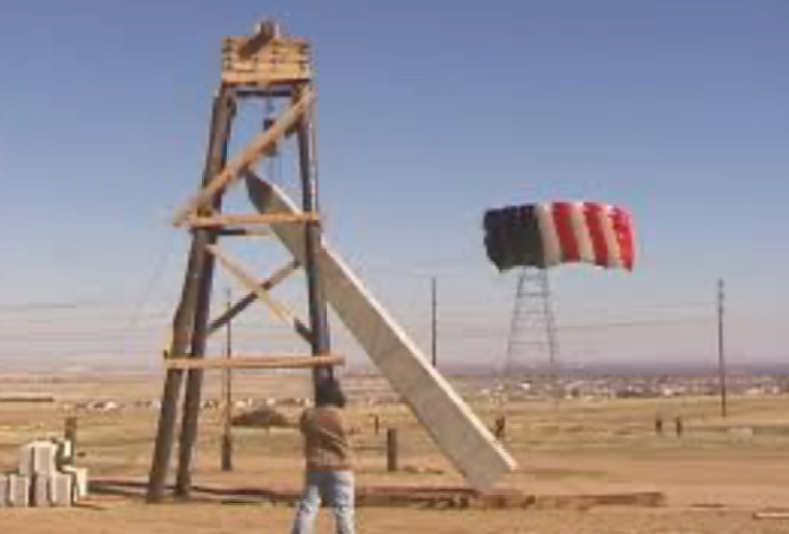
“Flying Pyramids, Soaring Stones” - Morteza Gharib
The following interview has been edited for clarity and length.
Can you tell us a little bit about yourself? Who are you? What is your background?
My name is Mory, Mory Gharib. Mory is a nickname for Morteza. That's something my mother called me as a kid and it stuck with me. I did most of my studies in engineering […] I'm an experimentalist with deep intention for understanding the underlying physics by either modeling or developing instruments that can measure certain things that are unusually difficult.
On the Caltech faculty now, I'm the chair of the aerospace department and also Director of the Center for Autonomous Systems and Technologies. I do all kind of things, from experiments, fluids, biomedical devices, medical devices, from heart valves to the stents for glaucoma to VTOL machines, flow control, and once in a while, art. That I think is right at the boundary of plasticity of mind, of my brain. Any artist can be a scientist, and vice versa, if they want to.
That is a perfect transition to start talking about your pieces in Spiraling Upwards. Can you tell us a little bit about that?
I have actually two things. I found that that Leonardo da Vinci was first one that built an artificial heart valve. And so, that’s one part of the exhibit, and the other one is called “Flying Pyramid.” And it started with a very enthusiastic businesswoman, who approached us at Caltech, and she was amazed by how Egyptians raised obelisks, and she told me that she thinks that they used some sort of kites. When she approached other universities, they all laughed at her. […] She came to Caltech expecting the same kind of reaction. And I said, you know, there must be some drawings, and she should see if there's something like that. And she showed us a drawing of a boat on the Nile being pulled by flying birds. But when I looked at it, I realized the aspect ratio [the length divided by the width] of the wings -- there's no birds in any part of the world that had that kind of aspect ratio. So I said, “Look, that's the evidence. There might be some kites.” So Egyptians and Tunisians are really avid sailors. They went around the world. And why not use the same power of sails [to raise an obelisk]? So she said, “Okay, what if I raise some money?” So I proposed that as a SURF (Summer Undergraduate Research Fellowship) project at Caltech.
“I think that we should not underestimate ancient engineers or scientists -- whatever they call them, they did crazy stuff.”
The idea was really difficult, because the obelisk is really tall and heavy. So our first idea was that if somebody used kites, you have the obelisk here, [shows a pen lying horizontal] and the kites flies, and raise this end up [uses hand to mime tipping the pen upright with its writing end up]. The inertia of this thing -- this is 20,000 pounds -- and you cannot stop it, so it's going to tip over. Finally, I got the idea maybe we should not do it this way, but instead we should actually pull it like this, [mimes holding the pen tip and lifting it vertically so that the end of the pen always remains on the ground as the pen gets dragged upright]. So that way, the end is always on the ground. And then the next thing was: how do we use wind energy? And then we realized that you need to have a scaffolding and a pulley with a fixed point here [at the top of the scaffold]. That way the kite can fly in any direction, but this point is fixed, so it's going to pull up here and raise the obelisk to this point. And then we realized, before we built the scaffold, that the kite surface area should be really huge [if you want a steady lift]. But suppose that you had the option of raising the obelisk in the steps. If you open [a newspaper] fast enough, the force that it generates has a huge peak, sometimes two, three times larger or higher than the steady state. So the students designed a technique that used a standard kitesurfing kite. You can buy it from shops. And every time we just hauled the obelisk up a certain amount. After two and a half years, they managed to raise a decent weight obelisk very quickly.
You know, it was really interesting as a study of unsteady lift processes. And the creativity students had in setting up a system! They had two rows of ropes going at least 300 feet. So every time they throw the kite to the wind, we would go along the ropes, lift up, and they pulled it back in. So it was very effortless, I would say. Lorraine wrote a book that’s now on Amazon: “Flying Pyramid.”
What a wild story. I have always had a soft spot for people trying out theoretical ways that people in the past could have gone about doing something.
You know, the size of the human brain hasn't changed in 20,000 years. And Egyptians did not watch TV all day, they're sitting by the banks of the Nile looking at wind. The creativity of human beings is amazing; if they could not write the equations, it doesn't mean they couldn't come up with idea. I think that we should not underestimate ancient engineers or scientists -- whatever they call them, they did crazy stuff.
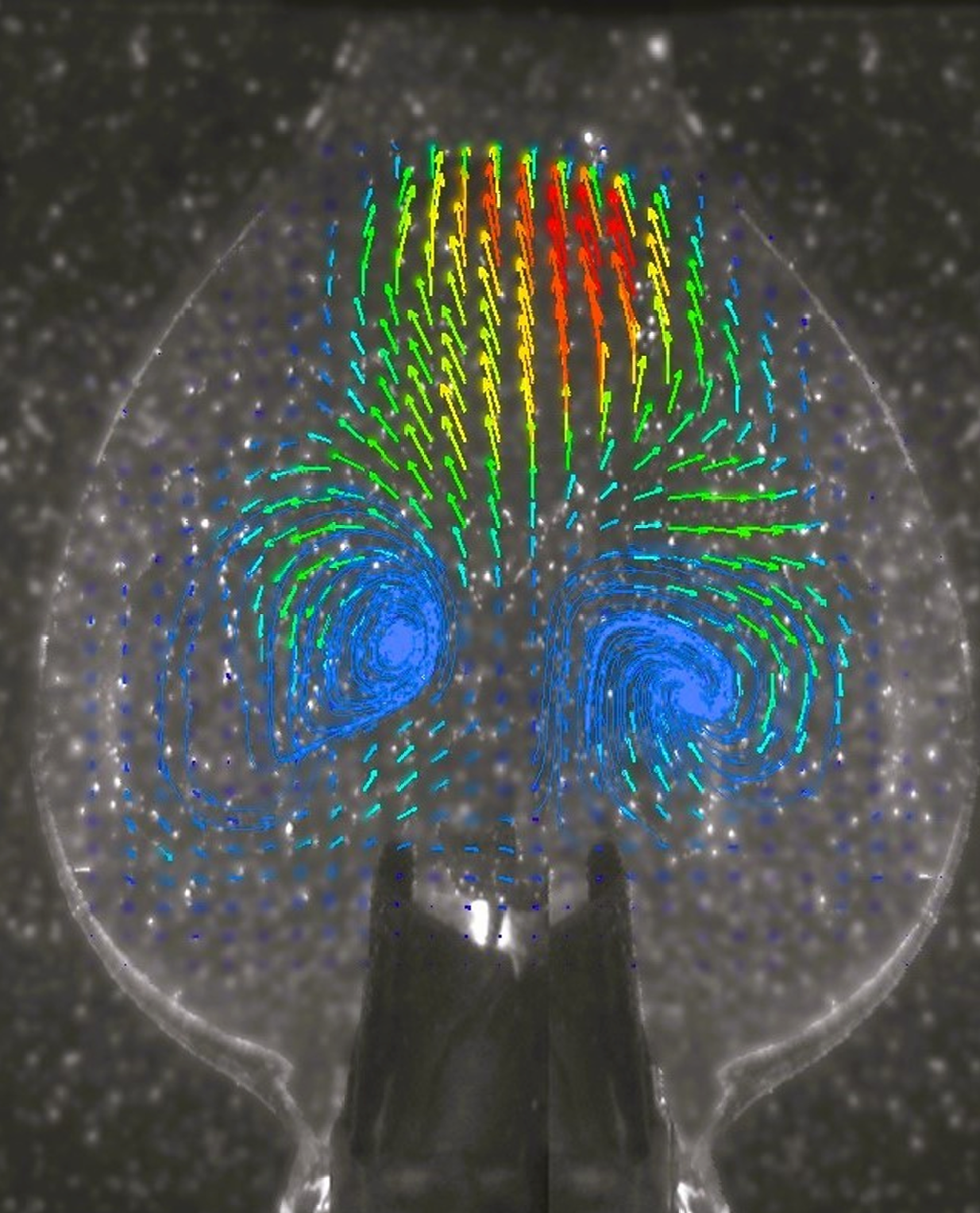
“Leonardo’s Depiction of Human Heart Valve Working” - Morteza Gharib
Speaking of people who did crazy stuff, I'm curious to hear about your thoughts on Leonardo da Vinci.
At first, I was really fascinated by, of course, his paintings. My brother took me to the Louvre many, many years ago and I thought, “Wow.”
My first encounter with him [as a scientist] was because I design heart valves -- artificial heart valves. Have you seen these drawings [da Vinci made] of the vortex coming out of an aortic valve? He writes that as the flow accelerates through the channel of the aorta, it forms a circulation, and that circulation helps to close the valve. And I thought, “How did you look at these things?” We cannot see through the body. They didn't have MRI or X-ray. Recently, we discovered, through a phase contrast MRI that, yes, formation of the vortex in the aorta helps the closure of the valve. So what happened?
[Leonardo da Vinci] actually took a calf heart, filled it with wax, and then made a glass model. Then he says, go to such and such place and buy silk, because they have the thinnest silk fabric, and then use this and that. And he tells exactly how to make a heart valve that mimics the one of the calf. And then he put it there in the glass model, and blows water into it, and uses grass seeds for particles. And then from there, he takes this understanding and puts those observations into the physiological drawings. And to me, that's a sign of real scientists, because if you don't understand something, you make a model of it, and we test it.
So, as a scientist, how do you feel having a piece in an art exhibit?
Well, it's gratifying. I've worked with the Getty Museum, and the Victoria and Albert; you know, the glass model was there for six months. People that saw it came back and said they were really excited, because they realized that we can take science and make it exciting, make [visitors] think things they have not seen before in this way. So for an engineer or scientist like me, it's important to show our way to artists and then get influenced by feedback. So for me, I love it. Because the problem is that in universities, we basically trap ourselves with the same kind of thinking all the time. And it's really important for us not to do that.
Last question: what do you hope that visitors will get from visiting Spiraling Upwards?
My thinking is that, if they go away and they don't look at anything the same way, then you’re successful.